Archive for the ‘Technology’ category

Learning & Compliance: Friends or Foes?

April 9th, 2013

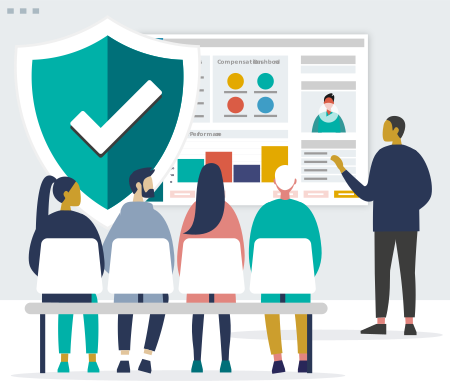
A few weeks ago, I wrote an article for the Inside Learning Technologies magazine on the role of learning systems in compliance training (“Is your LMS compliance friendly?”) Compliance is one of those topics that rarely get enough attention as one of the key drivers in our industry.

Survey-chart

Source: Compliance Survey 2012, Brandon Hall Group.

However, a recent survey by the Brandon Hall Group found out that regulatory and company compliance combined constitute the most important learning program for organizations’ business strategy today. In addition:

- Over 65% of organizations find it critically important or very important to demonstrate learning compliance to some external regulatory agency.

- At the same time companies understand that compliance is now impacting more on their workforces with over 60% of organizations claiming that compliance requirements involve more than three quarters of employees.

Just yesterday, it was reported that the Federal Aviation Administration announced a fine of $3.5mn to the Port Authority of New York and New Jersey for failing to train its police officers to perform rescues and fight fires. In addition to the fine, the Port Authority will need to take further measures to better oversee rescue and fire-fighting training compliance. According to the settlement, at JFK airport, the Port Authority allowed 77 police officers who were untrained for their duties to work 357 shifts from early May to early June 2012.

Compliance requirements for employees and organizations place new demands on learning systems that more traditional, developmental requirements do not. Our industry nowadays seems flooded with learning and talent management systems. But for such systems to succeed in a compliance-related role, they must be able to readily adapt to changing needs, operate at enterprise software level, and offer the requisite functionality around auditing, reporting, and security.

It is important that L&D and HR departments are up-to-date with the compliance requirements specific to their business. Here are a few suggestions to make this easier:

  1. Talk to your legal team and to your compliance officer to better understand who in the organization is responsible for what.
  2. Define clear requirements and objectives for training and the technology implementation.
  3. Question your vendor and demand a software validation for the learning or talent management system. For the technical parts, don’t be afraid to ask your IT team to participate.
  4. Make compliance an ongoing part of your business via well-defined workflows, checks & balances, and actionable reporting.
  5. When it comes to training, reinforce formal compliance learning with recurring programs. These initiatives may include informal collaborations (such as forums to discuss ongoing compliance issues), on-the-job assessments (to better evaluate the effectiveness of the compliance training), and performance support (to provide easy access to compliance-related materials at the point of need).

For more information, you can read the blog post from David Wentworth of The Brandon Hall Group on “The Problem with Canned Compliance” or, even better, join the webinar “Mission Critical: Managing Compliance Training in Europe” on April 16th.

SaaS – A “Disruptive Technology” and more (part 2 of 2)

March 24th, 2013

In part 1 of this post we analyzed SaaS as a “disruptive innovation” and what that may entail in terms of value to clients and SaaS providers.

Although SaaS is a well-understood model today, there are differences on how SaaS providers define SaaS (or their preferred flavor of SaaS). A number of leading SaaS vendors have claimed multi-tenancy as a necessary component of any SaaS offering. There is a fair amount of controversy here, but is multi-tenancy what defines SaaS?

As a quick backgrounder, multi-tenancy refers to a software architecture where a single instance of the software runs on a server, serving multiple tenants, where tenants are separate companies, or in a broader sense, any application – either inside or outside the enterprise – that needs its own secure and exclusive virtual computing environment. So how does multi-tenancy come to play?

» Read more: SaaS – A “Disruptive Technology” and more (part 2 of 2)

Technology and the future of our business

March 10th, 2013

I just read an article on Forbes magazine online about IBM CEO Ginni Rometty predicting three ways that technology will change the way we do business. The Forbes article was based on Ms Rometty’s speech at the Corporate Conference of the nonprofit Council on Foreign Relations. There is a video recording of this session here.

I couldn’t agree more with all the three ways that Ms Rometty analyses, and I believe all three of these ways profoundly affect the business we are in: human capital management.  Here’s how:

  1. Analytics – data analytics are coming to HR and the ability to harness talent-related data affects every talent-related function from hiring, to training, to engagement, to career development, to succession planning, to retention, to compensation, to dismissal.  Moreover, talent analytics provides the link between talent management processes, business metrics, and value creation.
  2. Social – it may sound like a cliché, but the new fabric of the enterprise is social and it is strategic.  Social technologies are enabling employee collaboration, knowledge and expertise sharing, people search and team formation, informal learning, continuous coaching and mentoring, and peer recognition models in a way that transcends formal organizational structures and redefines strict HR transactional processes.
  3. Personalization – we see personalization into the talent management as targeted recruitment, personalized learning and development plans, on-demand performance support, workplace technology consumerization, and individualized career paths. This is the point when talent management is transformed from an HR-driven process to a business-driven one.

These three ways are not predictions into the future, but instead they are changing our business today. Thoughts?

The ineluctable limits of logic

February 20th, 2013

David Brooks just wrote an opinion piece in The New York Times, What Data Can’t Do.

It’s really good; reasoned, nuanced, supported by relevant example and contextualized in the literature. Well worth reading.

It got me thinking about the limits of data-driven decision making in general. Bertrand Russell argued that no system can be understood by reference to anything from inside the system, no matter how clever the arguments. Ludwig Wittgenstein argued that nothing can be understood, or even adequately explained — period.

The data scientists are giving us amazing insights and trying to explain everything. They will doubtless continue to generate lots of actionable insight, including insight into the world of talent management, but they will fail at the “everything” part.

Everything is too tall an order.

Read Brooks’ piece. It’s food for thought.

Data driven decisions

January 2nd, 2013

Big Data is all the rage right now. Industry analysts and pundits of every stripe are singing the praises of analytics the way snake oil salesmen once hawked miracle potions to help us all live longer, healthier, more fulfilling lives.

Would that data analytics were as simple as buying a bottle of potion.

» Read more: Data driven decisions

SaaS – A “Disruptive Technology” and more (part 1 of 2)

November 7th, 2012

SaaS is, according to Clayton Christensen, Harvard professor and author of “The Innovator’s Dilemma”, a “disruptive technology or “disruptive innovation.” In a very basic way, it is disruptive to the way software has been traditionally marketed, sold, delivered, and maintained.
As a “disruptive innovation,” there are some fundamental truths that we can’t shy away from:

  1. Like every new “disruptive technology,” SaaS is probably not as good a solution all-around as an on-premise deployment. In a lot of cases, SaaS is still challenged in terms of interactivity, flexibility to customize, ease of integration, and security. However, what matters is not whether SaaS is as good a solution as on-premise deployments (or whether it will ever be), but whether SaaS is good enough to meet the needs of most companies – and this is really the tipping point.
  2. SaaS was built on the premise of delivery of software over the internet. Five years ago, this was challenging in terms of available web application technologies, enterprise integration points, and network bandwidth. Today, this is not the case as internet bandwidth and web services have rapidly progressed. Another tipping point.
  3. SaaS offers a cost advantage over on-premise, license-based software delivery models. This cost advantage is based on virtualization and resource sharing on the vendors’ side, but it also translates into more flexible, usage-based or pay-as-you-grow models for buyers.  And this advantage is not relevant to just small companies anymore, but to enterprise and global organizations as well. Yet again, another tipping point.
  4. As with every “disruptive technology,” the leading vendors of the prior generation of the technology, which is software here (see Oracle, SAP) are not likely to lead in the new generation, and new leaders are likely to emerge (see Salesforce.com, Workday). This is because leading companies tend to focus on immediate customer needs and short-term license revenue targets. Also, fear of cannibalizing their profitable product lines prevents them from making the necessary investments on disruptive, but necessary innovations.
  5. The best way for an existing leading company to become a serious player in the new generation following the “disruptive innovation” is to set up a separate entity with a different P&L center that will invest in this “disruptive technology” without any interference from existing lines of business.  Cannibalization down the line is inevitable, but at some point, if that new entity does indeed build a business off the new “disruptive technology,” it can become a catalyst for change for the entire company and into the new generation.  It’s probably too early to say, but SAP seems to be trying to follow this approach based on their actions after the acquisition of SuccessFactors.

In part 2 of this post, we will review the definition of SaaS and how it matters for vendors and buyers at the end of day.

NetDimensions at Learning 2012

October 11th, 2012

In the context of our continuing sponsorship of Learning 2012, Jay Shaw gave a podcast interview with Elliott Masie about industry trends & how NetDimensions has been responding to them. Mobile, integrated talent, compliance, analytics, global markets are some of the topics discussed.

Listen to Jay’s podcast with Elliott here.

The consumerization of process

August 8th, 2012

There is a great deal of talk about the consumerization of IT.

BYOD (Bring Your Own Device) policies, transitions to SaaS (Software as a Service) suppliers, private and public cloud infrastructure investments, etc.

However, there hasn’t been a lot of headline news about the consumerization of company processes. But it’s happening and it goes hand in hand with the system and hardware changes.

People expect not only to be able to use their own tools at work but also to be allowed to use company systems the same way they dip in and out of made-for-consumer systems and services.

This means, among other things, that companies have to rethink some of their top-down service delivery models and invest more in self-service models or at least in better employee-access models.

One of the knowledge management gurus at Green Chameleon posted a blog piece on just this issue in relation to employee engagement around employee generated content or EGC (as opposed to the retail world’s UGC acronym — User Generated Content).

You can find the blog piece here.

It’s worth reading.

SaaS vs. SaaS

July 28th, 2012

I just read Stan Swete’s Workday Innovation blog piece on what SaaS actually means (you can find it here). In the piece Swete ends up cribbing from SystematicHR’s simple and short definition: SaaS means a hosted service on a single code base.

Because we host and because we incorporate literally every single client customization into core engineering and take it all forward in our general releases, by Swete’s definition NetDimensions has always been a SaaS provider. In fact, we may well have been the first ever SaaS talent vendor.

But we’re special. We seem to be able to work technology magic other companies struggle with (it must be the Hong Kong air). We not only host, but we also provide licensed software for third-party hosting and for our clients’ on-premise implementations (some clients will never be able to buy externally hosted services).

I’m pretty sure this kind of flexibility on a single code base is unique. I don’t know of any other SaaS talent vendor who does this.

So for us there’s no ideological rift. There are no SaaS vs. License discussions at NetDimensions. We do both. We do both in the same way, at the same time and we do it for all of our clients.

If your SaaS provider is just as good as LinkedIn, you’re in trouble

July 26th, 2012

I have to say, recently I feel like anything but the life of the party. Security, data privacy, due care and related legal requirements — these are not fun issues. HR executives sometimes go to extraordinary lengths to avoid even talking about these things. Eyes glaze over. Subjects change. Comments like, “Let IT handle it,” or “The risk management folks will sort it out,” get bandied about.

People in the HR world generally don’t want to get up to speed on security competencies. But with LinkedIn getting hacked, things have changed. We all need to be paying attention.